Watershed Management
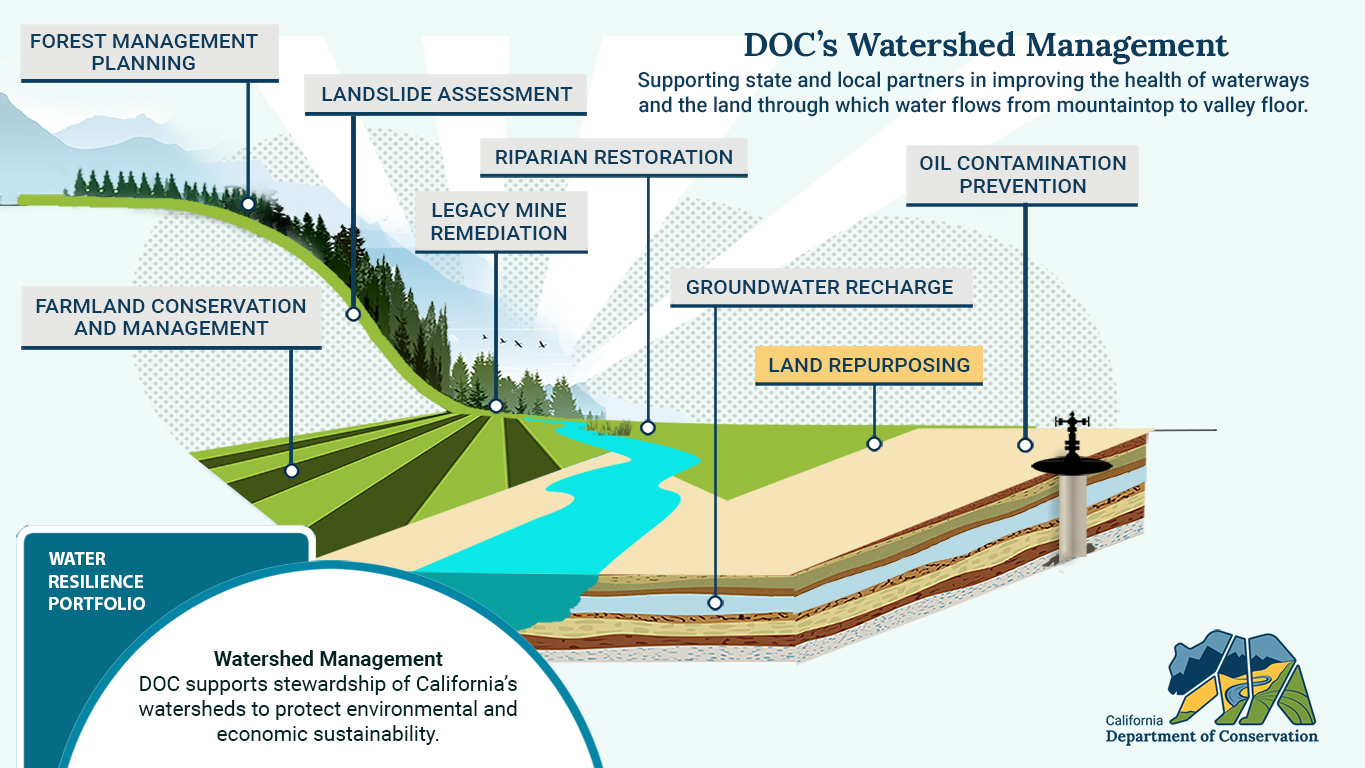
California’s communities and industries all depend on our watersheds: agriculture, industry, transportation, and recreation, just to name a few. Human activity in watersheds impacts their ecological function…also impacting, of course, their ability to be resilient and provide for the diverse array of services on which we depend.
California’s active geology and Mediterranean climate have combined to create a landscape that experiences drought every summer… and depends on healthy watersheds to channel winter precipitation to the parts of our state that need it most. In most cases, watersheds and the water resources they convey connect urban and rural spaces up and down our state.
Human activity and changes in climate are both dramatically affecting watershed functionality and the support we need them to provide: flashier precipitation means increased flood risk; warmer winters means heavier bark beetle populations; and increased greenfield development means more pressure on our precious agricultural land. While daunting, we know how we must adapt to these pressures, and the Department of Conservation is actively working with state and local partners to promote effective stewardship of our watersheds.
We bring time, money, and technical tools to empower active community leaders and builders with the resources they need to build resilience throughout our state. Here is just a sampling of the ways the Department of Conservation is bringing expertise to bear on some of California’s most wicked problems:
Diving Deeper
A great example of our response to current needs is our support for repurposing landscapes.
In early 2022, the Department of Conservation rolled out the Multibenefit Land Repurposing Program, a new program that supports inclusive and holistic community planning around landscapes in places where historic agricultural practices can no longer be applied due to groundwater scarcity. This is an ecological necessity, but also represents an opportunity for these affected communities. In some cases, these actions will give the groundwater aquifers an opportunity to recharge and to be available for future generations.
Watch Department of Conservation Director David Shabazian explain a brief history of land repurposing in California, and how it can support climate-resilient communities through the new Multibenefit Land Repurposing Program:
These forward-reaching programs cannot succeed without partnerships.
Learn more about our partnership efforts by reaching out to Elizabeth Betancourt, Natural and Working Lands Policy Advisor.

Meet Our Watershed Action Team
- Jenny DiStefano, Mandy Latzen of the Division of Land Resource Protection
- Cheryl Hayhurst, Jay Patton from the California Geological Survey
- Amit Garg, Baldev Gill, and Martin Jimenez of the Division of Geological Energy Management
- Amy Gomes, Claire Meehan from the Division of Mine Reclamation
Explore the Other Pillars

Carbon Management
Hazard Management
 Natural and Working Lands